
Top Signs You Need Garage Door Service – Don’t Ignore These
Most garage door failures don’t happen without warning. Springs stretch and unwind, cables fray, rollers flatten, and openers start straining weeks before anything actually breaks. The catch is that the early signs look small: a door that moves a little slower, a rattle you only hear from the kitchen, a gap at the floor you step over every day. Our job in this post is to help you tell the difference between a door that needs a tune-up and one with a part that’s about to fail. If you’d rather not climb up and inspect it yourself, call us at (855) 658-4106 and we’ll take a look.
A quick note on the big one: a door that’s slightly off-balance puts serious extra load on the opener motor every single cycle. Most homeowners read that slower movement as “the door’s getting old.” It’s usually a spring that’s losing tension, and it’s quietly wearing out the drive unit while you wait for it to get better.
Which Symptoms Are Cosmetic and Which Are Structural?
Cosmetic things can wait. Structural things can’t. The clearest way to sort them is by what the symptom tells you about the door’s moving parts, not how ugly it looks.
Surface rust on a steel panel, a dent from a backed-in car, faded paint, or a scuffed bottom section? Those are appearance issues. They’re worth addressing, but they don’t put anyone at risk. A Clopay or Amarr door with a dented panel still opens and closes safely.
Structural warnings are different. Look for these:
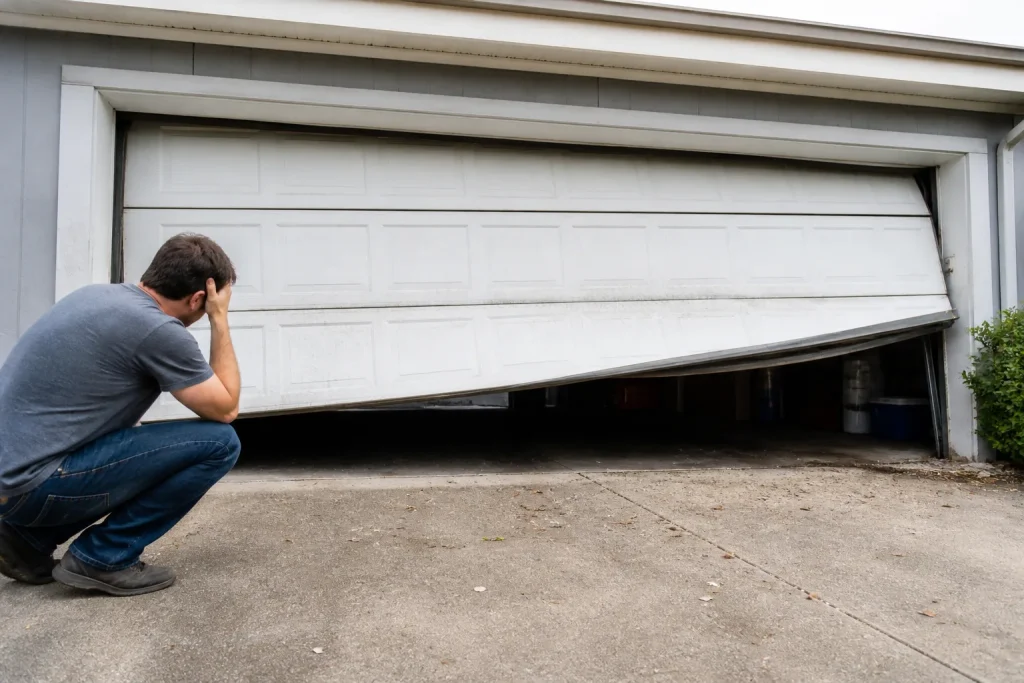
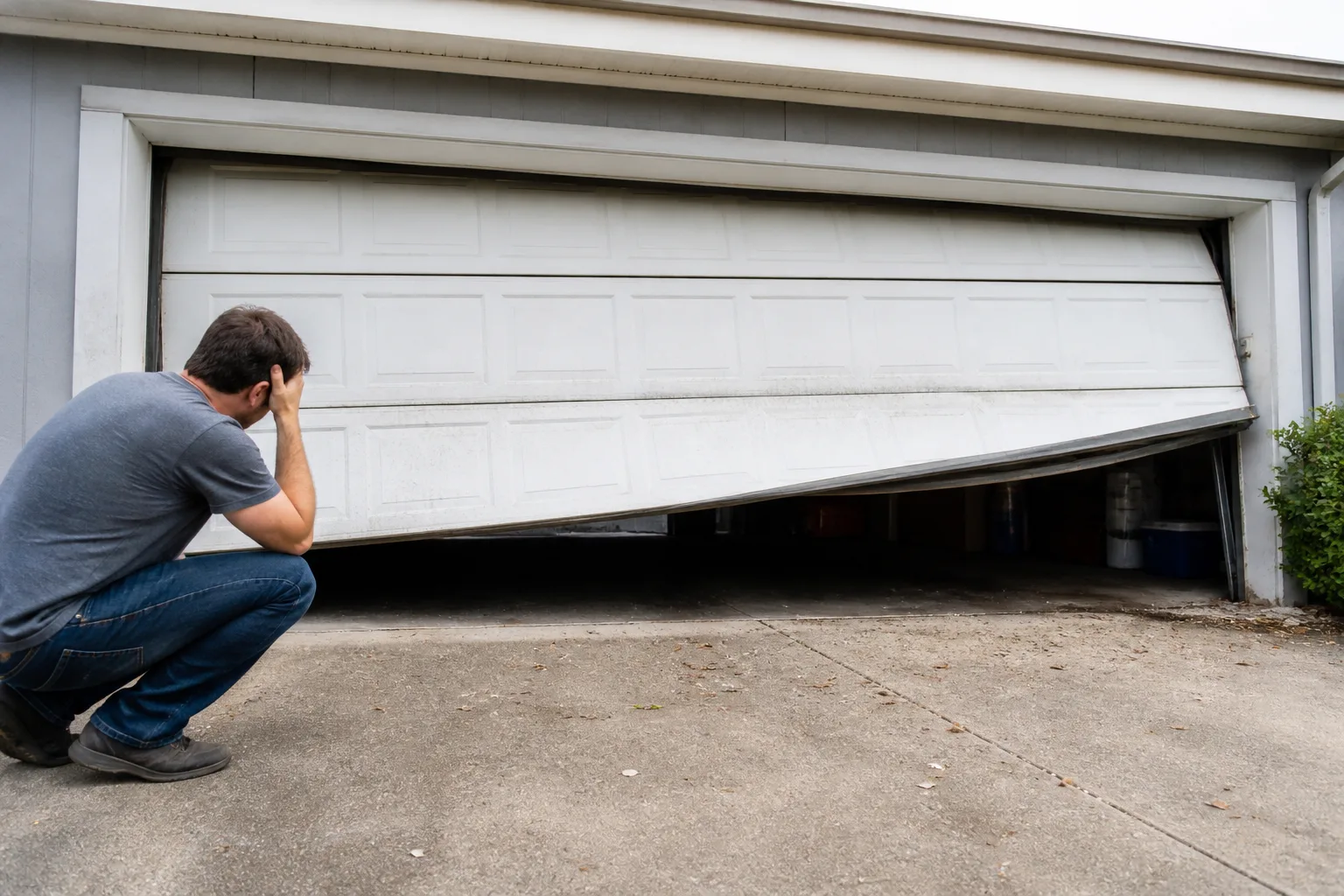
- An uneven gap at the floor. A door that doesn’t meet the ground evenly on both sides is usually out of balance, and the springs aren’t carrying the door the way they should.
- The door hesitating mid-travel. A pause or stall partway up or down points to binding tracks, a failing spring, or an opener working beyond its capacity.
- Visible cable fraying or slack on either side of the door.
- A door that won’t stay open when you stop it partway.
Any of those structural signs is a reason to stop cycling the door and get it looked at. In Channelview, we see a lot of doors that are mechanically fine but sound terrible, and just as many that look perfect and are one cycle from a snapped spring.
How Do You Do the Balance Test on a Garage Door?
The balance test tells you whether your springs are doing their job. With the door closed and the opener disconnected, lift the door by hand to about waist height and let go. A properly balanced door should stay roughly where you put it or drift only slightly. If it drops fast, sags, or feels far heavier than it should, the springs are losing tension or one has failed.
Two things to know before you try it:
- Disconnect the opener first. Most openers, whether a LiftMaster, a Genie, or an older Craftsman unit, have a manual release pull. Use it.
- Never test with a spring that’s visibly broken. A door with a snapped spring is hanging on cables and the opener. Don’t lift it, don’t cycle it, and don’t prop it up. Call for service instead.
Torsion springs, the coils mounted horizontally above the door, store an enormous amount of energy. They’re the single most dangerous component on a residential door, and the balance test is the closest a homeowner should get to them. If the door won’t hold itself up, that’s your answer. Leave the repair to a trained technician and don’t try to adjust or wind a spring yourself.
A Wayne Dalton door on a slightly older opener is a common combo in this area, and it’s a good example of why the balance test matters. When those two start fighting each other, the opener motor usually gives out before the spring does.
What Do the Different Noises Actually Mean?
The sound your door makes is a readable diagnostic. If you can describe it accurately when you call, we can often tell what’s wrong before we arrive. Here’s how to tell the common ones apart in Channelview:
- A sharp bang, like a gunshot, from above the door. That’s the sound of a torsion spring breaking. Stop using the door and call for garage door spring repair.
- A grinding or rumbling that rolls along with the door. Worn steel rollers or dry, rough tracks. Usually a tune-up fixes it, but let it go and the grinding starts chewing up the hinges and the door itself.
- A screech or squeal that rises and falls. A dry cable drum, dry rollers, or a hinge that needs lubrication. Less urgent than a bang, but it’s wearing parts down.
- A rhythmic clunk or thud near the top of travel. Often a loose bracket or a drum that’s starting to slip.
- Buzzing or grinding from the opener housing itself. That’s usually a gear or motor problem inside the unit, not the door.
Heat and humidity do their part here. The humid stretch of the year in Channelview works on steel cables and rubber seals in a way that drier places never see. Cables fray faster under constant moisture cycling, and bottom seals crack and pull away from the door sooner. A cable that’s just starting to fray is one of the earliest things we find on a routine inspection, and it’s also one of the cheapest to catch early.
Why Does My Door Sometimes Reverse or Stall?
A door that works “most of the time” but occasionally reverses right after closing, or stalls a few inches up, is not just quirky. Something is telling the opener to stop, and ignoring it just wears the system down further. Call us for garage door opener repair if the behavior keeps happening.
The usual suspects:
- Safety sensors out of alignment. The two small eyes near the floor on either side of the opening. A bump, a dirty lens, or a spider web can knock them out of line. The door reverses because the sensor thinks something (or someone) is in the way.
- A failing logic board. Intermittent reversing, random stopping, or the opener refusing to respond to the remote are classic signs of a control board on its way out. Modern LiftMaster and Chamberlain units have more electronics to go wrong, but older consumer openers fail this way too.
- Loose or worn limit settings. The opener loses track of where “fully open” and “fully closed” are.
- A binding door. If the door itself is dragging, the opener hits resistance and reverses on its safety trip.
A door that reverses occasionally is a safety feature doing its job. But a persistent pattern is a real fault, and the fix is usually quick once it’s diagnosed. Don’t keep cycling the door and hoping it settles down.
When Should You Call a Pro Instead of Waiting?
Some things are fine to watch. Some aren’t. Call for garage door repair the moment you notice a snapped spring, a slack or frayed cable, a door that won’t hold itself open, or a door that comes down unevenly and crushes the seal. Those are the problems that can hurt someone or damage the door beyond a simple fix.
Watch-and-wait items are smaller: a little grinding that’s new but not loud, a remote that’s getting sluggish, a slightly noisy door. A tune-up usually sorts those out, and catching them early keeps the cost down.
If you’re in Channelview and not sure which bucket your door falls into, describe what you’re hearing and seeing when you call. We work on the brands that dominate this area, so whether it’s a LiftMaster opener, a Genie, or a Wayne Dalton door, the technician who shows up already knows the system. Our technicians have up to 8 years of experience, and garage doors are the only thing we do, which means no guessing and no subcontracting the tricky jobs.
The Bottom Line
Not every symptom is an emergency, and not every symptom is cosmetic. The short version: a snapped spring, a frayed cable, or a door that won’t balance is a stop-using-it situation. A dent, a squeal, or a slow-moving door is worth a call before it turns into the expensive kind of problem. The balance test is your best free diagnostic. The noise profile is your second-best. If you’re in Channelview and want a trained eye on your door, Channelview Garage Door Repair Pros offers free estimates. Call (855) 658-4106. We answer 24/7. Fast dispatch from 7am to 7pm, Sunday through Friday.
Need us sooner? Our Channelview Garage Door Repair Pros team can usually get to you same day.
Frequently Asked Questions
The most common sign is a loud bang from above the door, followed by the door feeling extremely heavy and refusing to open at all. A visible gap in the coil above the door confirms it. Stop using the door and call for service. A spring under tension can cause serious injury, so leave the repair to a trained technician.
Not always. A new squeal or grind usually means dry rollers, worn rollers, or a tired hinge, and a tune-up fixes it. A sudden bang or a deep rumbling is more serious. The sound tells you what’s happening, so if you can describe it, that helps us diagnose before we arrive.
No. Intermittent reversing usually points to misaligned safety sensors or a failing logic board, and the fault tends to get worse, not better. It’s also a safety feature, so don’t assume it’s a quirk. It’s an inexpensive fix if it’s caught early.
Once a year is a good rule of thumb for most homes. The humidity and heat cycling here make cables and bottom seals wear faster than in drier climates, so an annual check catches fraying and seals before they become bigger repairs. If your door gets heavy use or lives on a busy street, consider a second check.
Written by the team at Channelview Garage Door Repair Pros.
Need Garage Door Help?
Call Channelview Garage Door Repair Pros - the local pro we connect you with is licensed and insured, here with fast help in Channelview.
(855) 658-4106